Privacy law in Vietnam – Website users’ information

Users’ information as personal information

Under Vietnamese laws, users’ information such as names, email addresses, passwords and date of birth could be classified as “personal information” (thông tin cá nhân). In particular,

(a)          Under Decree 72/2013, personal information is defined as information  which  is  attached  to  the  identification  of  the  identity  and personal  details  of  an  individual  including name,  age,  address,  people's  identity  card  number, telephone number, email address and other information as stipulated by law;

(b)          Under Circular 25/2010,  personal information means information sufficient to precisely identify an individual, which includes at least one of the following details: full name, birth date, occupation, title, contact address, email address, telephone number, identity card number and passport number. Information of personal privacy includes health record, tax payment record, social insurance card number, credit card number and other personal secrets.  Circular 25 applies to the collection and use of personal information by websites operated by Vietnamese Government authorities. Circular 25 is not directly applicable to the collection and use of personal information by websites operated by non-Government entities. However, the provisions of Circular 25 could be applied by analogy. In addition, it is likely that a non-Government entity will be subject to the same or more stringent standards than those applicable to a Government entity; and

(c)           Under Decree 52/2013,  personal information is information contributing to identifying a particular individual, including his/her name, age, home address, phone number, medical information, account number, information on personal payment transactions and other information that the individual wishes to keep confidential, excluding work contact information and other information that the individual himself/herself has published in the mass media.   

Users’ information as “secret of private life”

The Civil Code provides that an individual’s rights to “secrets of his/her private life” (bí mật đời tư) must be respected and shall be protected by law”. The Civil Code does not define what constitutes a secret of private life. However the following provisions may shed some lights on the meaning of secret of private life:

(a)          Decree 185/2013  defines “personal secrets” of a consumer to mean information pertaining to personal consumers in which consumers or relevant organizations or individuals have applied security measures, if such information is disclosed or used without their prior consents, such disclosure or use will cause negative effects on their health, lives, properties or other physical or mental damages to consumers.

(b)          Decree 52/2013 seems to suggest personal secrets to mean personal information that the relevant person wishes to keep confidential; and            

(c)           Circular 25/2010 considers health record, tax payment record, social insurance card number, credit card number and other personal secrets to be personal secrets.

In addition, in Vietnamese, the word “secrets” (bí mật) is usually understood as something which is being kept confidential and which is not disclosed to outsiders.  The word “private life” (đời tư) is usually understood as something that relates to one person only rather than things that are public or known to others.

In light of the above, if the user does not take measures to keep his user’s information confidential then such information may arguably not be regarded as “secrets of private life”. If this were the case, they would not be subject to the protection conferred by Article 38.1 of the Civil Code. In practice, other than passwords, an individual generally does not keep his/her name, email addresses or, except for very limited circumstances, date of birth confidential. Therefore, in general, passwords could be considered as secret of private life.

Users’ information as State secret

The Ordinance on State Secrets  defines State secrets as “information on cases, affairs, documents, objects, venues, time, speech, carrying important contents in the fields of politics, national defense, security, external affairs, economy, science, technology and other fields, which the State does not publicize or has not yet publicized and the disclosure of which will cause harm to the State of the Socialist Republic of Vietnam”. The definition of State secrets is very broad and general may cover certain personal information of certain individuals. For example,

(a)          unpublished details of high ranking State and political leaders may be regarded as “top secrets”; 

(b)          “information concerning deposits and other deposited property of customers at credit institutions”, and “customer codes used for identifying individual payment cards of the payment card users, credit cards and other types of cards used in banking operations; and passwords of computer users for remote access systems in banking sectors may be regarded as secret;  and

(c)           personal data of various State officials (especially those at high level positions or those working in sensitive sectors or organizations) may be regarded as secret.

Therefore, in theory, in certain limited scenario, website users’ information collected by a website operator may constitute State secret under Vietnamese law.
Take-or-pay clause in Vietnamese law contracts

In Vietnam, take-or-pay arrangement is quite common in long term supply or off-take contracts especially those relating large scale infrastructure projects with foreign sponsors  which require project financing.  A take-or-pay arrangement is essentially an agreement whereby the buyer agrees to either: (1) take, and pay the contract price for, a minimum contract quantity of goods annually (the TOP Quantity); or (2) pay the applicable contract price for such TOP Quantity (TOP Liability) if it is not taken during the applicable year.

It is not clear under Vietnamese law if the payment of TOP Liability by the buyer under in a long term contract could be viewed as a penalty. This is because:

  • Article 300 of the Commercial Law defines “penalty for breach” as a remedy whereby the aggrieved party requires the defaulting party to pay a penalty sum for breach of contract if so agreed in the contract; and
  • One can argue that the buyer’s failure to take TOP Liabilities is a breach of the long term contract and therefore the TOP Liability is a penalty to be paid by the Buyer.

If the TOP Liability is characterised as a penalty for breach then it is subject to a limit of 8% of the value of obligations which are in breach. To avoid this potential characterisation, the parties to a long term contract with a take-or-pay arrangement may consider characterising TOP Liability payment as adjustment to the sale price or payment for reservation of supplying capacity of the supplier. 

Vietnam Business Law Blog

The Government officially issued Decree 102/2026/NĐ-CP (Decree 102/2026), which introduces critical amendments and supplements to Decree 75/2019/NĐ-CP (Decree 75/2019) regarding administrative penalties for violations in the competition sector. Effective from 20 May 2026, Decree 102/2026 provides clearer enforcement guidelines and adjusts penalty frameworks, particularly for economic concentrations.

Below is a summary of the key changes introduced by Decree 102 that will directly affect M&A transactions subject to merger control (economic concentration notification) requirements in Vietnam.

In March 2026, Vietnam’s Ministry of Finance (MOF) released a draft decree (Draft Decree) implementing the Law on Personal Income Tax 2025 (PIT Law 2025) for public consultation. One proposal drew strong feedback from businesses and investors: a change to how individuals are taxed on the transfer of shares in non-public/unlisted joint-stock companies (JSCs). Following the consultation, the MOF now appears poised to step back from that change – welcome news for investors and companies engaged in M&A and private share transactions.

On 5 June 2026, the Government issued Decree 200 on private placement and trading of corporate bonds on domestic market and offering of corporate bonds on international market (Decree 200/2026). Decree 200/2026 will replace Decree 153/2020 on the same subject. In the past, Decree 153/2020 has been amended by Decree 65/2022 and Decree 8/2023. Decree 200/2026 introduces more conditions for private bond issuance.

5x debt/equity ratio

1.1.      Decree 200/2026 reflects the 5x debt/equity requirement established under the 2025 amendment to the Enterprise Law. In particular, the debt of a bond issuer (including the value of the bonds to be issued) must not exceed 5 times of the equity of such issuer as recorded in the audited financial statements of the year preceding the issuance.

On 15 May 2026, the Ministry of Finance issued Circular 55/2026/TT-BTC (Circular 55/2026), introducing a new set of forms for investment activities in Vietnam. Two specific changes in the new form of application for M&A Approval are notable for investors engaged in M&A transactions.

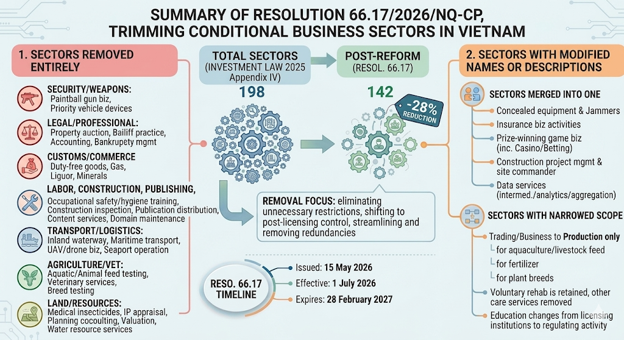
On 15 May 2026, the Government issued Resolution No. 66.17/2026/NQ-CP (the Resolution 66.17 or the new), slimming down the list of conditional business sectors currently set out in Appendix IV of Investment Law 2025 (the old).

Resolution 66.17 will take effect on 1 July 2026 and is set to expire on 28 February 2027, by which time the Government expects the National Assembly to formalise these adjustments through an amendment to Appendix IV. Although there would be a question about the effectiveness of the Resolution 66.17 over the Appendix 4 of Investment Law 2025 and how the investment authority will apply in practice, the investor may, in the meantime, treat the Resolution 66.17 as the working text for the next 9–10 months while following up on the law amendments.

Options in Vietnam

Option arrangements are used quite frequently in M&A transactions in Vietnam. Many foreign investors have used options or convertible securities as a mechanism to, among other things, acquire additional shares once the regulatory restriction is removed or to allocate commercial risks between the parties.

Generally speaking, an option arrangement should be valid for the following reasons:

  • Under Article 122 of the Civil Code, a civil transaction will be valid when it satisfies all of the following conditions: (a) persons participating in the transaction have capacity for civil acts; (b) the objective and contents of the transaction are not contrary to the law or social morals; and (c) persons participating in the transaction act entirely voluntarily. An option arrangement generally satisfies all these requirements and should be valid.
  •  Articles 6.1 and 6.7 of the Law on Securities recognize options as a form of securities. In particular, option to sell or option to buy is defined as a right stipulated in a contract which entitles a purchaser to choose the right to purchase or to sell a pre-determined volume of securities at a pre-determined price during a specified period.
  • Under Article 64 of the Commercial Law, options to purchase goods or options to buy goods are allowed to traded on a commodity exchange organized under the Commercial Law. In particular, call option or put option contract means an agreement whereby the option purchaser has the right to purchase or to be sold a certain type of goods at a pre-determined price (referred to as the contracted price) and must pay a certain amount of money for the purchase of this right (referred to as the option price). The option purchaser has the right to opt to carry out or not to carry out such purchase and sale of such goods. 

However, the major difficulty relating to option arrangement is that exercising an option is not an automatic process. In Vietnam, after an option is exercised, the parties usually have to obtain necessary regulatory or corporate approvals so that shares can be issued or transferred to the relevant option holder. Therefore, cooperation of the counterparties is essential for successfully exercising an option arrangement. Certain option arrangements appear to have been successfully implemented with the cooperation of the parties involved.

Another difficulty is that although there is law which generally recognizes options arrangements, there are few detail implementation rules and regulations or court precedents. Therefore, it is difficult to anticipate how the authorities including the courts and other authorities view and enforce an option arrangement in practice.

Vietnam Business Law Blog

The Government officially issued Decree 102/2026/NĐ-CP (Decree 102/2026), which introduces critical amendments and supplements to Decree 75/2019/NĐ-CP (Decree 75/2019) regarding administrative penalties for violations in the competition sector. Effective from 20 May 2026, Decree 102/2026 provides clearer enforcement guidelines and adjusts penalty frameworks, particularly for economic concentrations.

Below is a summary of the key changes introduced by Decree 102 that will directly affect M&A transactions subject to merger control (economic concentration notification) requirements in Vietnam.

In March 2026, Vietnam’s Ministry of Finance (MOF) released a draft decree (Draft Decree) implementing the Law on Personal Income Tax 2025 (PIT Law 2025) for public consultation. One proposal drew strong feedback from businesses and investors: a change to how individuals are taxed on the transfer of shares in non-public/unlisted joint-stock companies (JSCs). Following the consultation, the MOF now appears poised to step back from that change – welcome news for investors and companies engaged in M&A and private share transactions.

On 5 June 2026, the Government issued Decree 200 on private placement and trading of corporate bonds on domestic market and offering of corporate bonds on international market (Decree 200/2026). Decree 200/2026 will replace Decree 153/2020 on the same subject. In the past, Decree 153/2020 has been amended by Decree 65/2022 and Decree 8/2023. Decree 200/2026 introduces more conditions for private bond issuance.

5x debt/equity ratio

1.1.      Decree 200/2026 reflects the 5x debt/equity requirement established under the 2025 amendment to the Enterprise Law. In particular, the debt of a bond issuer (including the value of the bonds to be issued) must not exceed 5 times of the equity of such issuer as recorded in the audited financial statements of the year preceding the issuance.

On 15 May 2026, the Ministry of Finance issued Circular 55/2026/TT-BTC (Circular 55/2026), introducing a new set of forms for investment activities in Vietnam. Two specific changes in the new form of application for M&A Approval are notable for investors engaged in M&A transactions.

On 15 May 2026, the Government issued Resolution No. 66.17/2026/NQ-CP (the Resolution 66.17 or the new), slimming down the list of conditional business sectors currently set out in Appendix IV of Investment Law 2025 (the old).

Resolution 66.17 will take effect on 1 July 2026 and is set to expire on 28 February 2027, by which time the Government expects the National Assembly to formalise these adjustments through an amendment to Appendix IV. Although there would be a question about the effectiveness of the Resolution 66.17 over the Appendix 4 of Investment Law 2025 and how the investment authority will apply in practice, the investor may, in the meantime, treat the Resolution 66.17 as the working text for the next 9–10 months while following up on the law amendments.

Under Article 41 of the Law on Real Estate Business 2023 (Real Estate Business Law), a real estate project (Project) eligible for transfer may follow one of two sets of legal procedures, depending on how it was approved. While the difference may appear procedural at first glance, it has significant implications for when the transfer transaction is legally completed, and for what the parties can (or cannot) do if the transaction ultimately falls through. This post discusses the two procedures and the practical implications arising from the distinction between them.

Vietnam has temporarily raised several general economic concentration notification thresholds under Resolution No. 66.18 of the Government dated 18 May 2026 (Resolution 66/2026), a practical change for M&A transactions as fewer deals should be caught solely by Vietnamese assets, Vietnamese turnover or transaction value.

On 3 September 2025, the Ministry of Finance (MOF) released the Official Letter no. 13629 addressing questions related to difficulties and obstacles arising from legal regulations in the finance and investment sector. This correspondence has several notable issues that are summarized below. While some of the MOF’s guidance offers welcome flexibility and operational reassurance, others fall short of providing clear or comprehensive clarification, leaving important gaps unresolved and inconsistencies with other legislation unaddressed.

Delegation by the General Meeting of Shareholders endorsed in principle (Query no. 29)

Query/Issue raised:

Current regulations regarding delegation/authorisation (both could be translated to/from "uỷ quyền" in Vietnamese) by the General Meeting of Shareholders (GMS) to the Board are unclear and conflicting. […]

A recurring issue in Vietnam corporate governance is whether a former member of the Board of Directors can be appointed as an “independent” Board member in the subsequent term, provided that all other statutory criteria are satisfied. This typically arises where companies want to retain a former board member while still complying with independence requirements under Article 155.2 of the Enterprises Law 2020 as amended in 2025 (Enterprises Law 2020).

Under Article 155.2(dd) of Enterprises Law 2020, an independent Board member must “not hold the position of member of the Board of the company within the last 05 years or longer unless he/she was designated in 02 consecutive terms.

Vietnamese law currently lacks a formal definition of “latent defect” (khiếm khuyết ẩn) and a clear mechanism for allocating liability once such defects arise. This regulatory vacuum often leads to prolonged disputes between the Employer and the Contractor, particularly when the construction contracts do not include explicit risk allocation.

For the purpose of our discussion below, a “latent defect” is defined as a fault or flaw in construction works/item that is not discoverable through a reasonably thorough inspection at the time of handover.


Can an organisation act as an authorised representative?

Under Article 139.2 of the Civil Code, individuals, legal entities and other subjects may enter into and perform civil transactions through a representative. A representative could be a legal representative or an authorised representative. Article 139.5 of the Civil Code requires a representative must have “full capacity for civil acts” (năng lực hành vi dân sự).

The Civil Code only refers to “capacity for civil acts” in the context of an individual. In particular, Article 17 of the Civil Code provides that the capacity for civil acts of an individual is the capability of the individual to establish and exercise civil rights and perform civil obligations through his or her acts. Therefore, there has been an argument that by reference to “capacity for civil acts”, Article 139.5 of the Civil Code suggests that an authorised representative must be an individual and may not be an organisation. 

However, such an argument seems to be unreasonable and should not be accepted. This is because:

  • Although the Civil Code does not expressly cover capacity for civil acts for an individual, legal theory seems to recognise that an organisation can also have capacity for civil acts;
  • Article 92 of the Civil Code allows representative office or a branch office of a legal person to act as authorised representative of such legal person. Obviously, a representative office or a branch office is not an individual; and
  • Other legislation also expressly allow a legal person to act as an authorised representative of another person. For example, under the Law on Intellectual Property, the owner of a trademark may authorise a IP agent being an organisation to act on its behalf. Under the regulations on VAMC, the VAMC can authorise a local bank to act on behalf of the VAMC to collect any bad debt sold by such bank to VAMC (see here). 

Vietnam Business Law Blog

The Government officially issued Decree 102/2026/NĐ-CP (Decree 102/2026), which introduces critical amendments and supplements to Decree 75/2019/NĐ-CP (Decree 75/2019) regarding administrative penalties for violations in the competition sector. Effective from 20 May 2026, Decree 102/2026 provides clearer enforcement guidelines and adjusts penalty frameworks, particularly for economic concentrations.

Below is a summary of the key changes introduced by Decree 102 that will directly affect M&A transactions subject to merger control (economic concentration notification) requirements in Vietnam.

In March 2026, Vietnam’s Ministry of Finance (MOF) released a draft decree (Draft Decree) implementing the Law on Personal Income Tax 2025 (PIT Law 2025) for public consultation. One proposal drew strong feedback from businesses and investors: a change to how individuals are taxed on the transfer of shares in non-public/unlisted joint-stock companies (JSCs). Following the consultation, the MOF now appears poised to step back from that change – welcome news for investors and companies engaged in M&A and private share transactions.

On 5 June 2026, the Government issued Decree 200 on private placement and trading of corporate bonds on domestic market and offering of corporate bonds on international market (Decree 200/2026). Decree 200/2026 will replace Decree 153/2020 on the same subject. In the past, Decree 153/2020 has been amended by Decree 65/2022 and Decree 8/2023. Decree 200/2026 introduces more conditions for private bond issuance.

5x debt/equity ratio

1.1.      Decree 200/2026 reflects the 5x debt/equity requirement established under the 2025 amendment to the Enterprise Law. In particular, the debt of a bond issuer (including the value of the bonds to be issued) must not exceed 5 times of the equity of such issuer as recorded in the audited financial statements of the year preceding the issuance.

On 15 May 2026, the Ministry of Finance issued Circular 55/2026/TT-BTC (Circular 55/2026), introducing a new set of forms for investment activities in Vietnam. Two specific changes in the new form of application for M&A Approval are notable for investors engaged in M&A transactions.

On 15 May 2026, the Government issued Resolution No. 66.17/2026/NQ-CP (the Resolution 66.17 or the new), slimming down the list of conditional business sectors currently set out in Appendix IV of Investment Law 2025 (the old).

Resolution 66.17 will take effect on 1 July 2026 and is set to expire on 28 February 2027, by which time the Government expects the National Assembly to formalise these adjustments through an amendment to Appendix IV. Although there would be a question about the effectiveness of the Resolution 66.17 over the Appendix 4 of Investment Law 2025 and how the investment authority will apply in practice, the investor may, in the meantime, treat the Resolution 66.17 as the working text for the next 9–10 months while following up on the law amendments.

Under Article 41 of the Law on Real Estate Business 2023 (Real Estate Business Law), a real estate project (Project) eligible for transfer may follow one of two sets of legal procedures, depending on how it was approved. While the difference may appear procedural at first glance, it has significant implications for when the transfer transaction is legally completed, and for what the parties can (or cannot) do if the transaction ultimately falls through. This post discusses the two procedures and the practical implications arising from the distinction between them.

Vietnam has temporarily raised several general economic concentration notification thresholds under Resolution No. 66.18 of the Government dated 18 May 2026 (Resolution 66/2026), a practical change for M&A transactions as fewer deals should be caught solely by Vietnamese assets, Vietnamese turnover or transaction value.

On 3 September 2025, the Ministry of Finance (MOF) released the Official Letter no. 13629 addressing questions related to difficulties and obstacles arising from legal regulations in the finance and investment sector. This correspondence has several notable issues that are summarized below. While some of the MOF’s guidance offers welcome flexibility and operational reassurance, others fall short of providing clear or comprehensive clarification, leaving important gaps unresolved and inconsistencies with other legislation unaddressed.

Delegation by the General Meeting of Shareholders endorsed in principle (Query no. 29)

Query/Issue raised:

Current regulations regarding delegation/authorisation (both could be translated to/from "uỷ quyền" in Vietnamese) by the General Meeting of Shareholders (GMS) to the Board are unclear and conflicting. […]

A recurring issue in Vietnam corporate governance is whether a former member of the Board of Directors can be appointed as an “independent” Board member in the subsequent term, provided that all other statutory criteria are satisfied. This typically arises where companies want to retain a former board member while still complying with independence requirements under Article 155.2 of the Enterprises Law 2020 as amended in 2025 (Enterprises Law 2020).

Under Article 155.2(dd) of Enterprises Law 2020, an independent Board member must “not hold the position of member of the Board of the company within the last 05 years or longer unless he/she was designated in 02 consecutive terms.

Vietnamese law currently lacks a formal definition of “latent defect” (khiếm khuyết ẩn) and a clear mechanism for allocating liability once such defects arise. This regulatory vacuum often leads to prolonged disputes between the Employer and the Contractor, particularly when the construction contracts do not include explicit risk allocation.

For the purpose of our discussion below, a “latent defect” is defined as a fault or flaw in construction works/item that is not discoverable through a reasonably thorough inspection at the time of handover.

When companies think about data protection, they usually focus on “visible” data like names, email addresses, or bank details. However, there is a hidden layer called metadata - essentially “data about data” - that often gets ignored.

Under Vietnam’s new personal data protection rules, overlooking metadata is a major risk. If metadata can be used to identify a specific person, it falls under the same strict rules as regular personal data.

What is Metadata? The “Digital Footprint”

Metadata is information that describes the context of a file or a message rather than the content itself. Even if you remove a person’s name from a file, the metadata can still point directly to them.

Vietnam is currently at a pivotal stage of infrastructure modernization. To meet the immense demand for capital, the State has moved to revitalize private sector participation, most notably through the “Build – Transfer” (BT) model.

In a typical BT arrangement, a private investor finances and constructs an infrastructure project, then transfers it to the State upon completion. In return, the State “pays” the investor with land funds, allowing them to develop a “reciprocal project” (dự án đối ứng) to recover their capital and generate profit. While this mechanism is essential to stimulate private sector participation, the recent new legal framework for BT projects may raise significant concern regarding the land access privileges granted to BT investors compared to their counterparts in the general real estate market. In particular,

The recently issued Case Law No. 81/2024/AL (CL 81) introduces a precedent that allows creditors to bypass the standard statute of limitations by re-characterizing an unpaid contractual debt as a property reclamation claim upon the mutual termination of the contract and an agreement on the payable amount. Below are a few of our observations regarding CL 81.

Summary of the Case

The dispute originated from a service contract between Company M (the Service Provider) and Company A (the Client). After the Service Provider performed its services, the parties mutually agreed to terminate the contract. Subsequently, the Client explicitly confirmed in writing the specific amount of the service fee it owed to the Service Provider and the late payment interest but ultimately failed to make the payment. When the Service Provider filed a lawsuit to recover the unpaid amount, the Client requested the court to dismiss the case, arguing that the 3-year statute of limitations for a contractual dispute had already expired.

For investors in Vietnam, "contributing capital" to a company can mean two very different things: becoming a legal owner (member/shareholder of a company) or simply being a business partner. A recent case law no. 78/2025/AL clarifies this distinction and indicates that several pieces of evidence may be considered to prove company member/shareholder status.

Case Summary

In this dispute, Mr. H, the plaintiff, provided significant funds to D Limited Liability Company, which was managed by his relatives. Although Mr. H received the profit distribution for over a decade and signed minutes acknowledging his contribution, Mr. H was never officially recorded as a member of the company in the enterprise registration certificates (ERC) or the company’s charter.

When partnering with government agencies (G2B), the risks often come from policy changes and the adoption of new legislation, causing obstacles, delays, and payment backlogs in PPP contracts (especially BT contracts). Following the establishment of Steering Committee 751 (Ban Chỉ Đạo 751) to resolve investment projects with pending legal issues, the Government has recently prepared a Resolution Draft (the Draft) to address approximately 160 transitional BT projects still facing legal obstacles (such projects, “Pending BT Project”).

Focusing specifically on Pending BT Projects where land-use rights serve as the State’s payment mechanism, the following analysis highlights critical issues arising from the proposed changes introduced by this Draft:

On 31 December 2025, the Government issued Decree 356/2025 guiding the implementation of the PDPL 2025, which took effect on 1 January 2026. Decree 356/2025 provides critical detailed guidance and, notably, resolves several ambiguities under the PDPL 2025 framework. This post highlights the key takeaways from this new regulation.

1.         Expansion of "sensitive personal data": ID Cards and login credentials

As compared to the Draft PDPL Decree, Decree 356/2025 expands the scope of sensitive personal data to explicitly include:

On 11 December 2025, the National Assembly adopted new investment law (Investment Law 2025). On this blog, we discuss some key changes in the new Investment Law 2025.

Clarification of business investment conditions

The Investment Law 2025 refines the definition of business investment conditions (Điều kiện đầu tư kinh doanh) by introducing an explicit exclusion: these conditions no longer encompass technical standards and regulations issued by competent authorities concerning product or service quality. This addition narrows the scope of what constitutes a "conditional business line", distinguishing administrative market-entry conditions from mere technical product standards.

In a significant move to streamline the execution of the Land Law 2024, the National Assembly of Vietnam recently passed Resolution 254/2025 on specific policies and mechanism to resolve obstacles in implementation of the Land Law 2024. Effective from 1 January 2026, Resolution 254/2025 is intended to apply alongside the Land Law 2024 and prevails in case of conflict. In essence, Resolution 254/2025 could be considered as an amendment to the Land Law 2024.

In this post, we will summarize the key changes introduced under Resolution 254/2025.

1.           Expanded Scope for Land Recovery

Resolution 254/2025 introduces three additional scenarios under which the State may recover land to promote socio-economic development. Specifically, it now includes:

On 18 December 2025, the Vietnamese government issued Decree 323/2025 on the establishment of Vietnam International Financial Center (VIFC). Decree 323/2025 takes effect immediately and provides guidance for Article 8 and 9 of Resolution 222/2025 of the National Assembly on VIFC. In this post, we discuss some interesting points of Decree 323/2025

1. Single or multiple units

The National Assembly intends that VIFC is one single unit. To confirm this intention, Decree 323/2025 provides that VIFC is a unified legal unit (thực thể pháp lý thống nhất in Vietnamese). However, Vietnamese law does not have definition of legal unit (thực thể pháp lý). In addition, this provision of Decree 323/2025 also seems to contradict with Resolution 222/2025 which defines VIFC as an area with defined geographical boundaries.

However, by locating that single unit into two separate location, putting it under management of multiples authorties, and giving each location a different set of priorities, it is doubtful on how the operation of VIFC can be unified. This is evidenced by:

  • The VIFC is oddly named as “Viet Nam International Financial Center in Ho Chi Minh City (VIFC-HCMC) and Viet Nam International Financial Center in Da Nang City (VIFC-DN)” which compries two individual names within one single entity name.

  • The Operating Authority and Supervisory Authority of VIFC have legal person status, which implied that these authorities’ legal responsibility is independent with VIFC’s legal responsibility.

The Law on Artificial Intelligence (AI Law), which was passed by the National Assembly on 10 December 2025, is arguably among the most anticipated pieces of legislation of Vietnam in 2025.

Unfortunately, similar to the Law on Digital Technology Industry, Vietnam’s AI Law still feels like a half-baked legislation, which makes it hard to clearly identifying the key players in the artificial intelligence (AI) value chain. This article would examine several key terminologies under the AI Law.