Foreign borrowing conditions for private companies in Vietnam

Under Circular 12/2014 of the State Bank of Vietnam (SBV), a private company including foreign-invested companies in Vietnam can only borrow from a foreign lender if it satisfies the following requirements, among others:

  • A foreign loan can only be used to (1) implement an investment project of the borrower or of a company in which the borrower has “direct investment” capital; or (2) refinance existing foreign loans without increasing borrowing costs. (1) is a positive development as it allows the borrower to use a foreign loan proceed to make capital contribution or, even possibly, on-lend to another company. (2) seems to be more restrictive than earlier regulations and may make it more difficult for a Vietnamese company to restructure its foreign debt;
  •  A foreign loan with a term of no more than 1 year is considered as a short term loan. A short term foreign loan must not be used for medium or long term use. In practice, a short term foreign loan is not required to be registered with the SBV. However it must be made in writing before draw down;
  • The repayment and disbursement of a foreign loan of Vietnamese borrower being a foreign invested enterprise must be made through a foreign direct investment account in foreign currency opened by such borrower with a licensed bank in Vietnam. The bank will check all supporting documents before making any repayment to foreign lenders;
  • A medium and long term loan together with all other outstanding  long and medium term loans of must not exceed the difference between the total investment capital and the equity capital of the investment project as recorded in the relevant investment certificate. However, a short term loan is not subject to this restriction. This is a positive development as under old regulations a short term loan is also subject to the same funding limit except in limited circumstance;
  •  A medium and long term foreign loan must be registered with the SBV within 30 working days from the signing date of the loan agreement and before disbursement;
  • A foreign loan must be made in foreign currencies except for loans given to micro finance organisations, loans between the foreign investor in a foreign-invested company and such foreign-invested company; or loans approved the SBV; and
  • A foreign loan secured by shares or capital contribution or convertible bonds issued by a Vietnamese issuer must comply with the relevant foreign ownership limits. It is not clear if this means that the parties need to comply with the relevant foreign ownership limits at the time of taking or enforcing the relevant securities.  


Offshore guarantees by Vietnamese Companies

Under the amended Ordinance on Foreign Exchange, a Vietnamese entity (Vietnamese Guarantor) can only guarantee  for obligations of an offshore entity if it obtains an approval by the Prime Minister for doing so. Obtaining a Prime Minister’s approval makes it considerably difficult for a company in Vietnam to issue a guarantee for obligations of an offshore company (e.g. the parent company of a Vietnamese subsidiary). Circular 37/2013 of the State Bank of Vietnam (SBV) which takes effect from 14 February 2014 provides further guidance on an offshore guarantee by a Vietnamese Guarantor. In particular, 

  • Circular 37/2013 provides that the obligations to be guaranteed by a Vietnamese Guarantor need to be “financial obligations” (nghĩa vụ tài chính). There is no definition of financial obligations. It is not clear if this means that offshore guarantees for non-financial obligations can be issued without obtaining Prime Minister’s approval;
  • Circular 37/2013 requires the Vietnamese Guarantor to open a special account to pay for the guaranteed obligations and to receive reimbursement payment by the guaranteed entity; and
  • Circular 37/2013 requires the Vietnamese Guarantor to register the repayment obligations by the offshore guaranteed entity with the SBV after the Vietnamese Guarantor’s paying the guaranteed amount to the beneficiary. 


New Circular on exchange control over foreign indirect investment

Earlier this week, the State Bank of Vietnam (SBV) issued Circular 5/2014 regulating exchange control over foreign indirect investment. Circular 5/2014 will take effects from 28 April 2014 replacing the old Circular 3/2004 on similar issue. Circular 5/2014 reinforces  the requirement under Decree 160/2006 and the Ordinance on Foreign Exchange that all foreign indirect investment must be made in Vietnamese Dong and through an indirect investment capital account (tài khoản vốn đầu tư gián tiếp) which is commonly named as the “CCA”. That being said, a quick read of Circular 5/2014 raises the following issues:

  • Circular 5/2014 does not apply to foreign investors who are resident under the foreign exchange regulations including foreign individuals residing in Vietnam for 12 months or more.
  • A foreign investor cannot use the Vietnamese Dong amount in the CCA to make fixed-term deposit or saving deposit. This restriction appears to restrict foreign investors using the CCA to conduct carry trades in Vietnamese Dong.
  • Investment entrustment (ủy thác đầu tư) is now regarded as a form of indirect investment.
  • Circular 5/2014 does not apply to a foreign investor who purchases shares or makes capital contribution and who does not “directly” participate in the management and operation of the target company.  However, as in other earlier legislation, Circular 5/2014 fails to clarify which activity could amount to direct participation in the management and operation of a company.
  • If an indirect investment becomes a direct investment and the foreign investor does not have any other indirect investment, Circular 5/2014 requires the foreign investor to open a “direct investment capital account in Vietnamese Dong” and closes the CCA. However, a “direct investment capital account in Vietnamese Dong” is a new concept and has not been contemplated in earlier regulations such as Decree 160/2006 or the Ordinance on Foreign Exchange.
  • Circular 5/2014 also does not contemplate necessary procedures in case where a direct investment becomes an indirect investment.
  • By around 28 July 2014, all capital contribution and share purchase accounts opened under Circular 3/2006 must be renamed to indirect investment capital accounts. In addition, all foreign currencies deposited by foreign investors with securities companies must be converted into Vietnamese Dong and transferred to the CCA under Circular 5/2014.
Vietnam Business Law Blog

On 15 May 2026, the Ministry of Finance issued Circular 55/2026/TT-BTC (Circular 55/2026), introducing a new set of forms for investment activities in Vietnam. Two specific changes in the new form of application for M&A Approval are notable for investors engaged in M&A transactions.

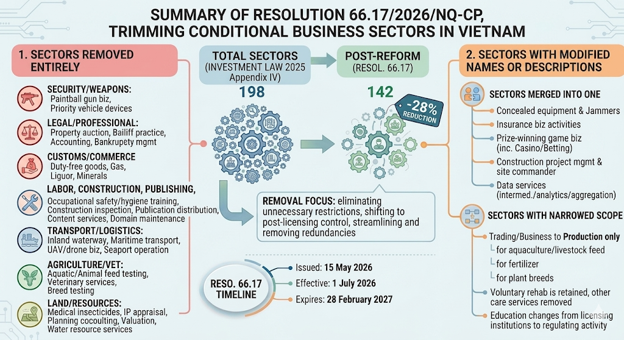
On 15 May 2026, the Government issued Resolution No. 66.17/2026/NQ-CP (the Resolution 66.17 or the new), slimming down the list of conditional business sectors currently set out in Appendix IV of Investment Law 2025 (the old).

Resolution 66.17 will take effect on 1 July 2026 and is set to expire on 28 February 2027, by which time the Government expects the National Assembly to formalise these adjustments through an amendment to Appendix IV. Although there would be a question about the effectiveness of the Resolution 66.17 over the Appendix 4 of Investment Law 2025 and how the investment authority will apply in practice, the investor may, in the meantime, treat the Resolution 66.17 as the working text for the next 9–10 months while following up on the law amendments.

Under Article 41 of the Law on Real Estate Business 2023 (Real Estate Business Law), a real estate project (Project) eligible for transfer may follow one of two sets of legal procedures, depending on how it was approved. While the difference may appear procedural at first glance, it has significant implications for when the transfer transaction is legally completed, and for what the parties can (or cannot) do if the transaction ultimately falls through. This post discusses the two procedures and the practical implications arising from the distinction between them.

Vietnam has temporarily raised several general economic concentration notification thresholds under Resolution No. 66.18 of the Government dated 18 May 2026 (Resolution 66/2026), a practical change for M&A transactions as fewer deals should be caught solely by Vietnamese assets, Vietnamese turnover or transaction value.

On 3 September 2025, the Ministry of Finance (MOF) released the Official Letter no. 13629 addressing questions related to difficulties and obstacles arising from legal regulations in the finance and investment sector. This correspondence has several notable issues that are summarized below. While some of the MOF’s guidance offers welcome flexibility and operational reassurance, others fall short of providing clear or comprehensive clarification, leaving important gaps unresolved and inconsistencies with other legislation unaddressed.

Delegation by the General Meeting of Shareholders endorsed in principle (Query no. 29)

Query/Issue raised:

Current regulations regarding delegation/authorisation (both could be translated to/from "uỷ quyền" in Vietnamese) by the General Meeting of Shareholders (GMS) to the Board are unclear and conflicting. […]

A recurring issue in Vietnam corporate governance is whether a former member of the Board of Directors can be appointed as an “independent” Board member in the subsequent term, provided that all other statutory criteria are satisfied. This typically arises where companies want to retain a former board member while still complying with independence requirements under Article 155.2 of the Enterprises Law 2020 as amended in 2025 (Enterprises Law 2020).

Under Article 155.2(dd) of Enterprises Law 2020, an independent Board member must “not hold the position of member of the Board of the company within the last 05 years or longer unless he/she was designated in 02 consecutive terms.

Vietnamese law currently lacks a formal definition of “latent defect” (khiếm khuyết ẩn) and a clear mechanism for allocating liability once such defects arise. This regulatory vacuum often leads to prolonged disputes between the Employer and the Contractor, particularly when the construction contracts do not include explicit risk allocation.

For the purpose of our discussion below, a “latent defect” is defined as a fault or flaw in construction works/item that is not discoverable through a reasonably thorough inspection at the time of handover.

When companies think about data protection, they usually focus on “visible” data like names, email addresses, or bank details. However, there is a hidden layer called metadata - essentially “data about data” - that often gets ignored.

Under Vietnam’s new personal data protection rules, overlooking metadata is a major risk. If metadata can be used to identify a specific person, it falls under the same strict rules as regular personal data.

What is Metadata? The “Digital Footprint”

Metadata is information that describes the context of a file or a message rather than the content itself. Even if you remove a person’s name from a file, the metadata can still point directly to them.

Vietnam is currently at a pivotal stage of infrastructure modernization. To meet the immense demand for capital, the State has moved to revitalize private sector participation, most notably through the “Build – Transfer” (BT) model.

In a typical BT arrangement, a private investor finances and constructs an infrastructure project, then transfers it to the State upon completion. In return, the State “pays” the investor with land funds, allowing them to develop a “reciprocal project” (dự án đối ứng) to recover their capital and generate profit. While this mechanism is essential to stimulate private sector participation, the recent new legal framework for BT projects may raise significant concern regarding the land access privileges granted to BT investors compared to their counterparts in the general real estate market. In particular,

The recently issued Case Law No. 81/2024/AL (CL 81) introduces a precedent that allows creditors to bypass the standard statute of limitations by re-characterizing an unpaid contractual debt as a property reclamation claim upon the mutual termination of the contract and an agreement on the payable amount. Below are a few of our observations regarding CL 81.

Summary of the Case

The dispute originated from a service contract between Company M (the Service Provider) and Company A (the Client). After the Service Provider performed its services, the parties mutually agreed to terminate the contract. Subsequently, the Client explicitly confirmed in writing the specific amount of the service fee it owed to the Service Provider and the late payment interest but ultimately failed to make the payment. When the Service Provider filed a lawsuit to recover the unpaid amount, the Client requested the court to dismiss the case, arguing that the 3-year statute of limitations for a contractual dispute had already expired.

Can a foreign bank acquire 100% shares in a Vietnamese joint stock bank?

There has been an argument that under the new Decree 1/2014 a foreign bank may acquire 100% of the shares in a Vietnamese joint stock bank (Local Bank) if (1) the Local Bank is, among other things, a “weak credit institution”, and (2) the Prime Minister approves to increase the foreign ownership limit in the relevant Local Bank to 100%. However, in order for a foreign bank to acquire 100% of the shares in a Local Bank, various legal issues still need to be clarified. In particular,

  •  It is not clear if Decree 1/2014 is applicable to the scenario where a foreign bank acquires shares in Local Bank and becomes a single-member LLC bank owned by the foreign bank. Decree 1/2014 allows the Prime Minister to increase the foreign ownership limit in a Local Bank. However, Decree 1/2014 appears to be drafted on the assumption that the Local Bank will remain to be a joint stock bank even after the acquisition by a foreign bank. For example, all of the provisions in Decree 1/2014 regarding rights and obligations of a foreign investor after acquiring a Local Bank refer to “share” and “shareholders”.
  • A Local Bank is required to have at least 100 shareholders under the Law on Credit Institutions. If a foreign investor acquires 100% of the shares in a Local Bank, the Local Bank will become a 100% foreign-invested bank existing in the form of a single member limited liability company (LLC). The Law on Credit Institutions and Decree 59/2009 currently do not have any specific procedures for converting a local joint stock bank into a single-member LLC bank owned by a foreign bank. Instead, the Law on Credit Institutions and Decree 59/2009 only generally provide that conversion (chuyển đổi) of legal corporate form of a joint stock bank requires State Bank’s approval. As such presumably, the conversion of a local joint stock bank into a single-member LLC bank will need to follow the procedures under the Enterprise Law and Decree 102/2010. This means that, among other things, the conversion would require (1) super majority approval by the General Meeting of Shareholder of the Local Bank and (2) the share purchase price by the foreign bank to be determined according to market price or price determined by certain valuation methods.
  • After a 100% acquisition, the Local Bank will become a 100% foreign-invested bank. Therefore, presumably, the foreign investor will need to satisfy the conditions of setting up a 100% foreign-invested bank in Vietnam in addition to the conditions of acquiring shares in Local Bank in Vietnam.
  • A Local Bank is also a public joint stock company in Vietnam. Therefore, acquiring 100% shares in a Local Bank will be subject to the tender offer rules under the securities law unless an exemption is granted by the General Meeting of Shareholders.
  • A conversion of a Local Bank into a single-member LLC bank owned by a foreign bank would require (1) consent by all of the shareholders of the Local Bank for selling their shares to the foreign bank and (2) super majority approval by the Local Bank’s shareholders. If a shareholder in the Local Bank objects to the 100% acquisition, it may be difficult to complete the acquisition voluntarily. Under the Law on Credit Institutions, only when a Local Bank is put under “special control” (kiểm soát đặc biệt) by the State Bank, the State Bank may compel the Local Bank to be acquired by another bank or by the State Bank itself. Even in case of special control, the legal ground and procedures for a compulsory transfer of shares is still unclear and untested.
Vietnam Business Law Blog

On 15 May 2026, the Ministry of Finance issued Circular 55/2026/TT-BTC (Circular 55/2026), introducing a new set of forms for investment activities in Vietnam. Two specific changes in the new form of application for M&A Approval are notable for investors engaged in M&A transactions.

On 15 May 2026, the Government issued Resolution No. 66.17/2026/NQ-CP (the Resolution 66.17 or the new), slimming down the list of conditional business sectors currently set out in Appendix IV of Investment Law 2025 (the old).

Resolution 66.17 will take effect on 1 July 2026 and is set to expire on 28 February 2027, by which time the Government expects the National Assembly to formalise these adjustments through an amendment to Appendix IV. Although there would be a question about the effectiveness of the Resolution 66.17 over the Appendix 4 of Investment Law 2025 and how the investment authority will apply in practice, the investor may, in the meantime, treat the Resolution 66.17 as the working text for the next 9–10 months while following up on the law amendments.

Under Article 41 of the Law on Real Estate Business 2023 (Real Estate Business Law), a real estate project (Project) eligible for transfer may follow one of two sets of legal procedures, depending on how it was approved. While the difference may appear procedural at first glance, it has significant implications for when the transfer transaction is legally completed, and for what the parties can (or cannot) do if the transaction ultimately falls through. This post discusses the two procedures and the practical implications arising from the distinction between them.

Vietnam has temporarily raised several general economic concentration notification thresholds under Resolution No. 66.18 of the Government dated 18 May 2026 (Resolution 66/2026), a practical change for M&A transactions as fewer deals should be caught solely by Vietnamese assets, Vietnamese turnover or transaction value.

On 3 September 2025, the Ministry of Finance (MOF) released the Official Letter no. 13629 addressing questions related to difficulties and obstacles arising from legal regulations in the finance and investment sector. This correspondence has several notable issues that are summarized below. While some of the MOF’s guidance offers welcome flexibility and operational reassurance, others fall short of providing clear or comprehensive clarification, leaving important gaps unresolved and inconsistencies with other legislation unaddressed.

Delegation by the General Meeting of Shareholders endorsed in principle (Query no. 29)

Query/Issue raised:

Current regulations regarding delegation/authorisation (both could be translated to/from "uỷ quyền" in Vietnamese) by the General Meeting of Shareholders (GMS) to the Board are unclear and conflicting. […]

A recurring issue in Vietnam corporate governance is whether a former member of the Board of Directors can be appointed as an “independent” Board member in the subsequent term, provided that all other statutory criteria are satisfied. This typically arises where companies want to retain a former board member while still complying with independence requirements under Article 155.2 of the Enterprises Law 2020 as amended in 2025 (Enterprises Law 2020).

Under Article 155.2(dd) of Enterprises Law 2020, an independent Board member must “not hold the position of member of the Board of the company within the last 05 years or longer unless he/she was designated in 02 consecutive terms.

Vietnamese law currently lacks a formal definition of “latent defect” (khiếm khuyết ẩn) and a clear mechanism for allocating liability once such defects arise. This regulatory vacuum often leads to prolonged disputes between the Employer and the Contractor, particularly when the construction contracts do not include explicit risk allocation.

For the purpose of our discussion below, a “latent defect” is defined as a fault or flaw in construction works/item that is not discoverable through a reasonably thorough inspection at the time of handover.

When companies think about data protection, they usually focus on “visible” data like names, email addresses, or bank details. However, there is a hidden layer called metadata - essentially “data about data” - that often gets ignored.

Under Vietnam’s new personal data protection rules, overlooking metadata is a major risk. If metadata can be used to identify a specific person, it falls under the same strict rules as regular personal data.

What is Metadata? The “Digital Footprint”

Metadata is information that describes the context of a file or a message rather than the content itself. Even if you remove a person’s name from a file, the metadata can still point directly to them.

Vietnam is currently at a pivotal stage of infrastructure modernization. To meet the immense demand for capital, the State has moved to revitalize private sector participation, most notably through the “Build – Transfer” (BT) model.

In a typical BT arrangement, a private investor finances and constructs an infrastructure project, then transfers it to the State upon completion. In return, the State “pays” the investor with land funds, allowing them to develop a “reciprocal project” (dự án đối ứng) to recover their capital and generate profit. While this mechanism is essential to stimulate private sector participation, the recent new legal framework for BT projects may raise significant concern regarding the land access privileges granted to BT investors compared to their counterparts in the general real estate market. In particular,

The recently issued Case Law No. 81/2024/AL (CL 81) introduces a precedent that allows creditors to bypass the standard statute of limitations by re-characterizing an unpaid contractual debt as a property reclamation claim upon the mutual termination of the contract and an agreement on the payable amount. Below are a few of our observations regarding CL 81.

Summary of the Case

The dispute originated from a service contract between Company M (the Service Provider) and Company A (the Client). After the Service Provider performed its services, the parties mutually agreed to terminate the contract. Subsequently, the Client explicitly confirmed in writing the specific amount of the service fee it owed to the Service Provider and the late payment interest but ultimately failed to make the payment. When the Service Provider filed a lawsuit to recover the unpaid amount, the Client requested the court to dismiss the case, arguing that the 3-year statute of limitations for a contractual dispute had already expired.