Applicability of Vietnamese Internet Regulations to foreign website
An offshore website may be subject to Vietnamese internet regulations in certain cases. In particular,
- under Decree 72/2013, foreign organizations and individuals must comply with applicable Vietnamese laws in case public information provided by such foreign organizations and individuals involve users in Vietnam or access from Vietnam. Public information is defined as information which is stored, transmitted, collected and processed via the network and made public to all entities without the need to identify specific name or address of such entities; and
- an offshore website which provides a platform to connect Vietnamese users or to allow Vietnamese users to share information may be subject to regulations on social network in Vietnam.
Must a business obtain both the child's consent and the consent of the child's legal representative, a parent or guardian (dual consent), whenever it processes the personal data of a child aged 7 or over? Under the Personal Data Protection Law (PDPL), the answer is no. Dual consent is required only for processing that would disclose the child's private life or personal secrets. For other processing, the legal representative consents on the child's behalf, and the child's own consent is not required (Article 24.2 of the PDPL). However, Decree 330/2026 of the Government on administrative penalties for violations in the fields of cybersecurity and personal data protection (Decree 330/2026) seems to apply dual consent to a broader set of circumstances. Article 60.1(c) of Decree 330/2026 fines processing of the data of a child aged 7 or over without dual consent. That rule was taken from Decree 13/2023, which ceased to have effect on 1 January 2026.
The State Bank of Vietnam (SBV) officially issued Circular 38/2026/TT-NHNN dated 31 July 2026 on foreign exchange management for foreign investment activities in Vietnam (Circular 38/2026). Effective from 18 August 2026, Circular 38/2026 replaces Circular 06/2019/TT-NHNN (Circular 06/2019) as amended by Circular 03/2025/TT-NHNN (Circular 03/2025), which has governed the direct investment capital account (DICA) regime since 2019. Circular 38/2026 also terminates Articles 11.3 and 11.4 of Circular 03/2025 on opening and use of VND-denominated accounts for conducting foreign indirect investment in Vietnam and amends Circular 16/2014/TT-NHNN on the use of foreign currency and Vietnamese dong accounts of residents and non-residents.
A typical share sale agreement (SPA) takes effect on signing. Closing, when the buyer and the seller exchange money and title to the shares, usually comes later, once conditions have been met. One might expect tax on the sale to be imposed when the shares are sold, that is, at closing. But where a foreign enterprise with no permanent establishment (Foreign Seller) in Vietnam sells shares in an unlisted Vietnamese company to a resident buyer, Article 5.2(a) of Circular 20/2026 provides that revenue is taxed when the initial capital-transfer contract takes effect. On the face of that Article, the SPA can be that contract, and signing can be when it takes effect. The fact that closing has not yet occurred might not, by itself, defer the tax. Until Circular 20/2026, that was not so.
Similar to the Enterprise Law 2005 and the Enterprise Law 2014, the Enterprise Law 2020 is silent on whether founding shareholders may hold voting preference shares newly issued after the issuance date of the enterprise registration certificate (ERC), and only provides at Article 116.1 that the voting preference of founding shareholders is effective for three years from that date. This blog will examine different views on this issue.
On the one hand, one may support the view that founding shareholders are entitled to hold voting preference shares issued after ERC issuance date because:
Based on Resolution No. 206/2025/QH15 of the National Assembly on special mechanisms to address difficulties and obstacles arising from legal regulations, the Government has issued several Resolutions on administrative procedure reduction (such as Resolution 66.16/2026/NQ-CP, Resolution 66.18/2026/NQ-CP, etc.). Most of these provisions remain effective until 28 February 2027. If new provisions covering the same subject matter are promulgated to replace them during this period, the relevant provisions of these Resolutions will automatically cease to be effective.
On 16 March 2026, the Ministry of Public Security (MPS) issued the draft decree on administrative sanctions in the fields of cybersecurity and personal data protection (the Draft Decree) for public consultation. It is the first step to put concrete penalties behind the PDPL 2025, which took effect on 1 January 2026 but left the enforcement details to the Government. The Draft covers a wide range of sectors, such as cybersecurity, personal data, AI, telecommunications, and digital signatures. This post focuses on the personal data provisions (Articles 57 to 69 of the Draft Decree), which raise potential concerns for businesses.
On 5 June 2026, the Government issued Decree 200 on private placement and trading of corporate bonds on domestic market and offering of corporate bonds on international market (Decree 200/2026). Decree 200/2026 will replace Decree 153/2020 (as amended) on the same subject. We have discussed certain contents of Decree 200/2026 in New Decree on private bonds (Part 1) — Vietnam Business Law.
The Government officially issued Decree 102/2026/NĐ-CP (Decree 102/2026), which introduces critical amendments and supplements to Decree 75/2019/NĐ-CP (Decree 75/2019) regarding administrative penalties for violations in the competition sector. Effective from 20 May 2026, Decree 102/2026 provides clearer enforcement guidelines and adjusts penalty frameworks, particularly for economic concentrations.
Below is a summary of the key changes introduced by Decree 102 that will directly affect M&A transactions subject to merger control (economic concentration notification) requirements in Vietnam.
In March 2026, Vietnam’s Ministry of Finance (MOF) released a draft decree (Draft Decree) implementing the Law on Personal Income Tax 2025 (PIT Law 2025) for public consultation. One proposal drew strong feedback from businesses and investors: a change to how individuals are taxed on the transfer of shares in non-public/unlisted joint-stock companies (JSCs). Following the consultation, the MOF now appears poised to step back from that change – welcome news for investors and companies engaged in M&A and private share transactions.
On 5 June 2026, the Government issued Decree 200 on private placement and trading of corporate bonds on domestic market and offering of corporate bonds on international market (Decree 200/2026). Decree 200/2026 will replace Decree 153/2020 on the same subject. In the past, Decree 153/2020 has been amended by Decree 65/2022 and Decree 8/2023. Decree 200/2026 introduces more conditions for private bond issuance.
5x debt/equity ratio
1.1. Decree 200/2026 reflects the 5x debt/equity requirement established under the 2025 amendment to the Enterprise Law. In particular, the debt of a bond issuer (including the value of the bonds to be issued) must not exceed 5 times of the equity of such issuer as recorded in the audited financial statements of the year preceding the issuance.
On 15 May 2026, the Ministry of Finance issued Circular 55/2026/TT-BTC (Circular 55/2026), introducing a new set of forms for investment activities in Vietnam. Two specific changes in the new form of application for M&A Approval are notable for investors engaged in M&A transactions.
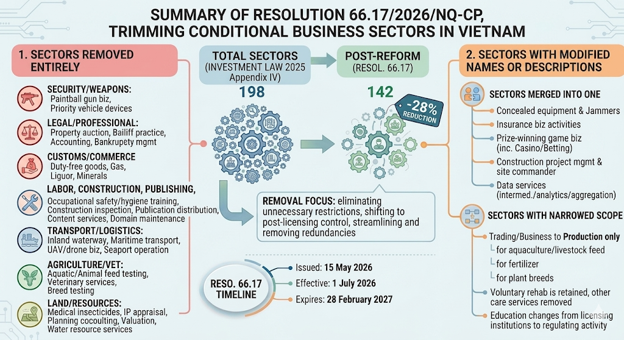
On 15 May 2026, the Government issued Resolution No. 66.17/2026/NQ-CP (the Resolution 66.17 or the new), slimming down the list of conditional business sectors currently set out in Appendix IV of Investment Law 2025 (the old).
Resolution 66.17 will take effect on 1 July 2026 and is set to expire on 28 February 2027, by which time the Government expects the National Assembly to formalise these adjustments through an amendment to Appendix IV. Although there would be a question about the effectiveness of the Resolution 66.17 over the Appendix 4 of Investment Law 2025 and how the investment authority will apply in practice, the investor may, in the meantime, treat the Resolution 66.17 as the working text for the next 9–10 months while following up on the law amendments.
Under Article 41 of the Law on Real Estate Business 2023 (Real Estate Business Law), a real estate project (Project) eligible for transfer may follow one of two sets of legal procedures, depending on how it was approved. While the difference may appear procedural at first glance, it has significant implications for when the transfer transaction is legally completed, and for what the parties can (or cannot) do if the transaction ultimately falls through. This post discusses the two procedures and the practical implications arising from the distinction between them.
The Government officially issued Decree 342/2026/ND-CP dated 3 September 2026, detailing the Commercial Law and the Law on Foreign Trade Management on the sale and purchase of goods and activities directly related to the sale and purchase of goods by foreign investors and foreign-invested enterprises (FIEs) in Vietnam (Decree 342/2026).
Effective from 18 October 2026, Decree 342/2026 replaces Decree 09/2018/ND-CP (Decree 09/2018), which has governed the Business License and Retail Outlet License regime since 2018. However, FIEs holding Business Licenses and Retail Outlet Licenses issued before 18 October 2026 may continue the licensed activities under their existing licences.